

A few weeks ago, something happened that many people thought was impossible.
Eliud Kipchoge ran a marathon in less than two hours.
For years, many people believed this simply couldn’t be done. Yet once Kipchoge crossed that finish line, the impossible suddenly became possible. In fact, another runner, Kenenisa Kejelcha, finished close behind him.
History is full of examples like this.
In 1954, Roger Bannister became the first person to run a mile in under four minutes. For decades, experts believed the human body wasn’t capable of it. Yet just 46 days later, Australian runner John Landy broke Bannister’s record.
Back in 1519, Ferdinand Magellan sailed beyond the horizon and proved that sailors wouldn’t fall off the edge of the world. What had been feared for centuries was no longer dangerous.
Once someone proves something is possible, our beliefs begin to change.
And that matters because anxiety thrives on one thing:
The unknown.
Think back to your first day at a new job.
You probably felt nervous, worried about getting things wrong or not fitting in.
But after just a few days, the anxiety started to fade.
Nothing magical changed. You simply became familiar with the environment. You watched how things were done, learned where things were, who people were, and what was expected of you.
The unknown became known.
And that’s exactly how anxiety works.
When something feels unfamiliar, your brain sees risk.
Your brain’s job is to keep you safe, so it naturally becomes cautious around things it doesn’t understand.
But every time you step into that unknown and survive it, your brain gathers new evidence:
“Maybe this isn’t as dangerous as I thought.”
The more evidence you collect, the less threatening the situation feels.
Your comfort zone expands.
The Journey From Impossible to Able
When we’re anxious about something, we often jump straight to the conclusion:
“I can’t do that.”
But here are four simple steps that we can all take from the Impossible to being able.
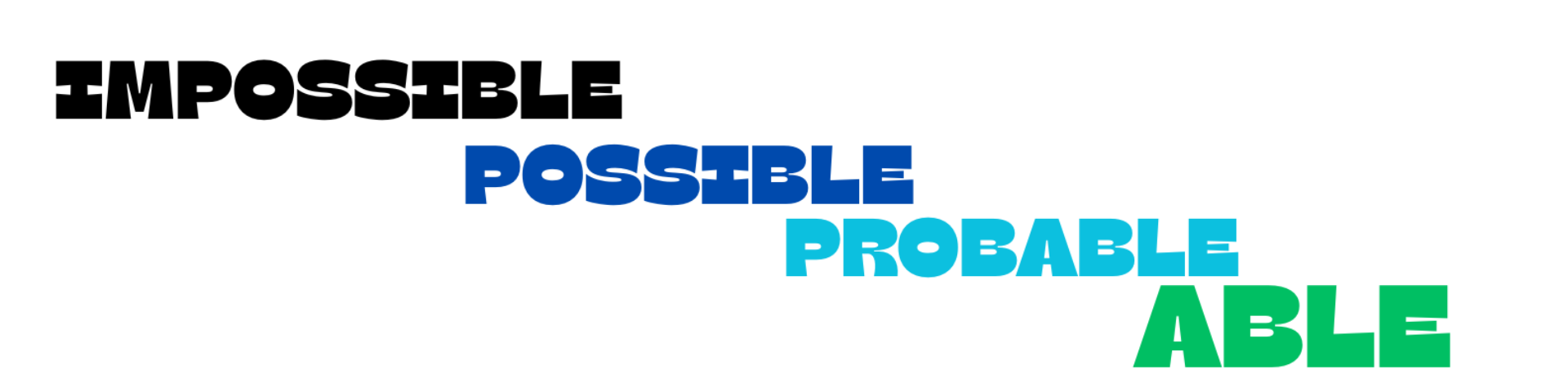
Stage 1: Impossible
At this stage, the challenge feels completely beyond you.
You might think:
The key word here is feel.
It feels impossible, but feelings aren’t facts.
Stage 2. Possible
The moment you discover someone else has done it, your perspective shifts.
If another person has faced the same fear and succeeded, your brain has evidence that it can be done.
The impossible becomes possible.
Stage 3. Probable
This is where learning begins.
Instead of focusing on fear, you focus on skills.
Ask yourself:
Marathon runners don’t just admire Kipchoge. They study him.
They learn from his training, routines, mindset and preparation.
The same applies to anxiety.
If someone has overcome a fear similar to yours, learn from them.
Read books. Listen to podcasts. Speak to people who have already walked the path.
Every piece of learning reduces uncertainty.
Every reduction in uncertainty reduces anxiety.
Stage 4. Able
This stage comes through practice.
Avoid seeking perfection.
Think about learning to walk.
It’s one of the most complicated things humans ever learn to do. It requires balance, coordination, sensory processing and muscle control all happening simultaneously.
Yet most of us master it before we’re two years old.
Why?
Because babies don’t expect instant success.
They watch, copy.
They wobble and fall.
They get back up and keep practicing.
And eventually they walk.
What was once impossible becomes something they do without thinking.
The same process applies to every fear you’ll ever face.
The next time anxiety tells you that something is impossible, try this simple process:
Look for evidence.
Someone has probably overcome a similar challenge before you.
Their success proves the possibility.
Discover what helped them.
What skills did they develop?
What mindset shifts did they make?
What practical steps did they take?
Don’t aim for perfection.
Aim for progress.
Take one small action that stretches your comfort zone.
Then another.
Then another.
Confidence isn’t something you wait for.
It’s something you build through repeated experience.
Every small success teaches your brain that you’re safer and more capable than you first believed.
Most things that make us anxious aren’t actually impossible.
They’re simply unfamiliar.
The journey from fear to confidence isn’t about eliminating anxiety overnight.
It’s about moving through four simple stages:
And every time you take a small step into the unknown, you move a little further along that path.
The people you admire didn’t start out fearless.
They simply learned what was possible, developed the necessary skills, and practised until they became able.
You can do exactly the same.
Caroline Cavanagh, the Anxiety Alchemist, is an anxiety specialist and hypnotherapist in Salisbury, Wiltshire. She is an author and mental health speaker and loves showing people how you can change anxiety from something you struggle with, into a catalyst for growth. Let’s chat.
Comment